Future trends in education are moving toward more personalised, flexible, and technology-supported approaches to learning. This shift is taking place as educators and institutions respond to misinformation, rising educational costs, funding uncertainty, and the rapid adoption of artificial intelligence (AI).
Many of these transformations fall under the umbrella of EdTech, and current EdTech trends focus on adapting teaching and learning to students’ changing needs through technology. From apps that turn learning into a game, like Duolingo, to instructors creating bite-sized lessons to match students’ short attention spans, learners of all ages and education levels can benefit from technological advancements.
Students benefit most when these tools respond to real learning needs. Used well, they can create more accessible ways to participate, connect with others, and make meaningful progress.
Key takeaways:
-
Schools are using personalised learning platforms, hybrid instruction, immersive tools, and AI to support more flexible teaching and learning.
-
With 88% of U.S. public schools operating 1-to-1 computing programs in the 2024–25 school year, districts need reliable processes for device access, repair, maintenance, and replacement.
-
As AI use grows in classrooms, educators need clear practices for verifying outputs, checking sources, and guiding students on appropriate use of the technology.
-
Schools are using EdTech data more directly in instruction, with diagnostic results helping teachers identify students’ needs and adjust lesson plans.
-
In this evolving educational climate, it’s most important for teachers and school districts to be adaptable and have a plan for technological readiness.
Current trends in education driving change
As online learning has become more common, EdTech tools and digital platforms have taken on a larger role in the delivery of education. That shift has also made the limits of one-size-fits-all instruction more visible, since students often need different levels of pace, support, and challenge.
With adaptive learning platforms — such as DreamBox Learning and Smart Sparrow — instructors can identify gaps, adjust lesson plans, and tailor learning experiences to meet individual students’ needs.
In the higher ed space, more classrooms have become equipped with video tools, such as Zoom, to offer remote and hybrid learning experiences. Students increasingly expect learning to be flexible and easy to access, and educational technology can help schools provide that flexibility across different learning environments
10 future trends in education that will transform learning
Modern education trends include personalised learning, hybrid and remote models, AI-powered teaching, immersive VR/AR, gamification, data-driven instruction, digital literacy, sustainable technology use, global collaboration, and equitable access to devices and connectivity.
1. Personalised learning & adaptive technology
Personalised learning occurs when the curriculum is tailored to each student’s strengths, weaknesses, and needs. According to Gallup’s 2025 Student Report Card, U.S. students rated schools significantly better than in 2024 for adapting instruction to their learning styles. Students still see room for improvement, however. Personalised learning remained one of the lowest-rated areas of school performance in the report.
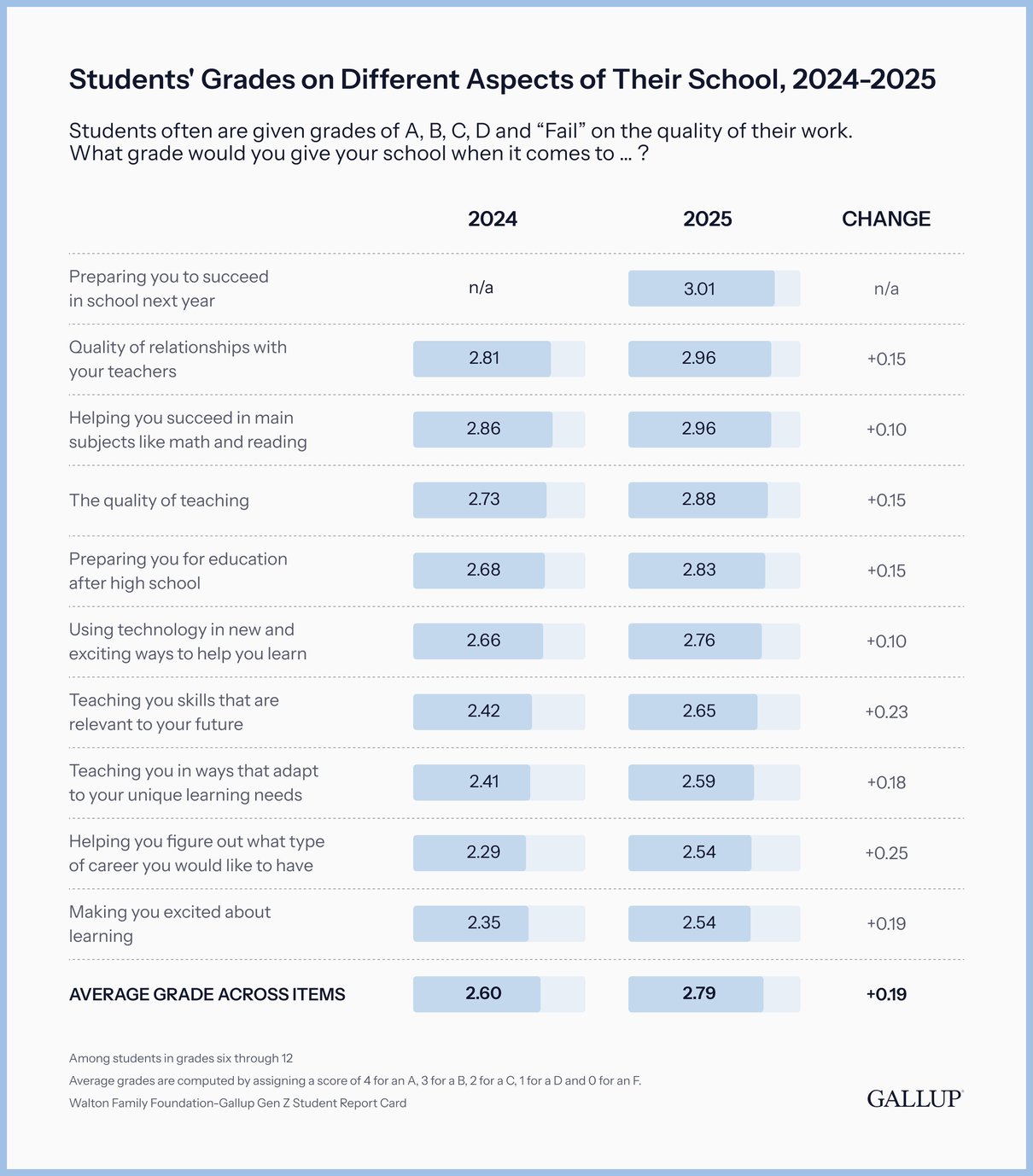
Letter grades that Gen Z students award their schools, 2023-2025. Source: Gallup.
The improvement can be achieved through EdTech platforms, including AI-driven ones such as 360Learning and Sana Labs, and corresponding data analytics that allow teachers to view progress and make lesson-related adjustments.
2. Hybrid and remote learning models
Hybrid and remote learning have become established options across U.S. higher education, giving students more ways to combine study with work and other commitments.
According to the National Center for Education Statistics, 26% of students at Title IV institutions were enrolled exclusively in distance education courses in fall 2024, while another 27.8% took some, but not all, of their courses remotely.
3. AI-powered teaching and assessment tools
Teaching involves far more than delivering instruction. Assignments also need to be reviewed, graded, and accompanied by meaningful feedback. Teachers are increasingly using EdTech solutions, particularly AI, to support instructional tasks.
For example, a 2026 review from Stanford Graduate School of Education’s SCALE Initiative cites a nationally representative 2025 RAND survey in which 53% of English language arts, math, and science teachers reported using AI for instructional tasks, such as lesson planning, assessment, and generation of instructional materials.
AI-powered tools, such as Gradescope and Testportal, can generate test questions and provide proctoring with comprehensive insights. These tools can help analyse student performance to develop more tailored lesson plans.
4. Immersive learning (VR/AR)
Virtual and augmented reality are moving from pilot projects into broader classroom use. For example, in 2025, Pennsylvania’s Allentown School District invested in 1,150 VR headsets across 24 schools, creating 66 XR learning environments for a district serving more than 17,000 students.
This education technology gives students access to immersive experiences that would be difficult to reproduce in a conventional classroom. VR can support virtual field trips and simulations, while AR can add digital information or models to the physical learning environment.
5. Gamification and interactive learning platforms
Current teaching trends increasingly include gamification and interactive platforms that give students more active ways to engage with lessons.
According to a TalentLMS survey, “83% of learners report feeling motivated when their training includes game elements.” An example of a gamification tool commonly used is Duolingo. Gamification also provides instruction in “bite-sized” lessons, helping to teach students with shortened attention spans.
6. Data-driven decision-making in education
Data-driven decision-making helps schools identify student needs and adjust instruction based on evidence rather than assumptions. In practice, teachers and administrators can use assessment, attendance, and other student-level data to decide where additional support is needed and whether an intervention is working.
Recent U.S. data shows how common this approach has become. In June 2025, the National Center for Education Statistics reported that 91% of public schools used diagnostic assessment data to identify individual students’ academic needs and support learning recovery.
7. Focus on digital literacy and 21st-century skills
As education technology trends increasingly include generative AI, educators need stronger AI literacy alongside broader digital skills. Teachers increasingly need to evaluate AI-generated content, verify sources, write effective instructions, and recognise when AI output should not be trusted.
OpenAI explains that language models can produce plausible but false statements because they predict likely continuations rather than verify every generated claim against a source of truth.
These confident but inaccurate outputs are known as hallucinations. Hallucinations remain a known limitation of large language models, including newer systems, rather than a problem confined to earlier AI models such as GPT-4o. Recognising these hallucinations and verifying AI-generated information are becoming core skills of 21st-century digital literacy.
8. Sustainability and green campus initiatives
Schools are under growing pressure to reduce waste and make better use of existing technology. That means considering how long devices stay in service, how often they are replaced, and whether underused equipment can be redeployed.
According to 2025 sustainability procurement guidance from CoSN, SETDA, and UDT, schools can face annual device damage rates of 8% to 25%, making repairability, maintenance, and longer product lifecycles important considerations in technology procurement and K-12 device management.
9. Global collaboration in learning projects
International education now depends on more than students physically crossing borders. Even when offshore enrollment fluctuates, universities can maintain cross-border teaching through overseas campuses, partner institutions, and distance delivery.
Physical mobility remains part of that exchange. For example, the Australian Department of Foreign Affairs and Trade reports that around 5,000 Australian students study in the U.S. and 7,900 U.S. students study in Australia each year.
At the same time, cross-border education can continue without relocation. According to the Australian Government Department of Education, Australia recorded 107,437 offshore higher-education enrollments in 2024 through overseas campuses, institutional partnerships, and distance education.
10. Equity and inclusion through tech access
Schools around the world have begun providing devices to students — regardless of family income — to create a sense of technological equity. For example, according to the National Center for Education Statistics, 88% of U.S. public schools had a 1-to-1 computing program in the 2024–25 school year, providing every student with a school-issued device.
Schools in other developed education systems also report broad access to digital devices. A 2025 OECD analysis found that 96.1% of students across participating OECD countries had access to a desktop or laptop computer at school.
But there is more to equity in education than just devices. Students also need reliable internet access at home to use online platforms, complete assignments, and participate in remote learning when required.
Access to reliable home internet has also improved, but connectivity remains uneven across households. A 2026 Pew Research Center analysis found that 78% of U.S. adults subscribed to home broadband in 2025. Adoption ranged from 54% among households earning under $30,000 to 94% among households earning $100,000 or more.
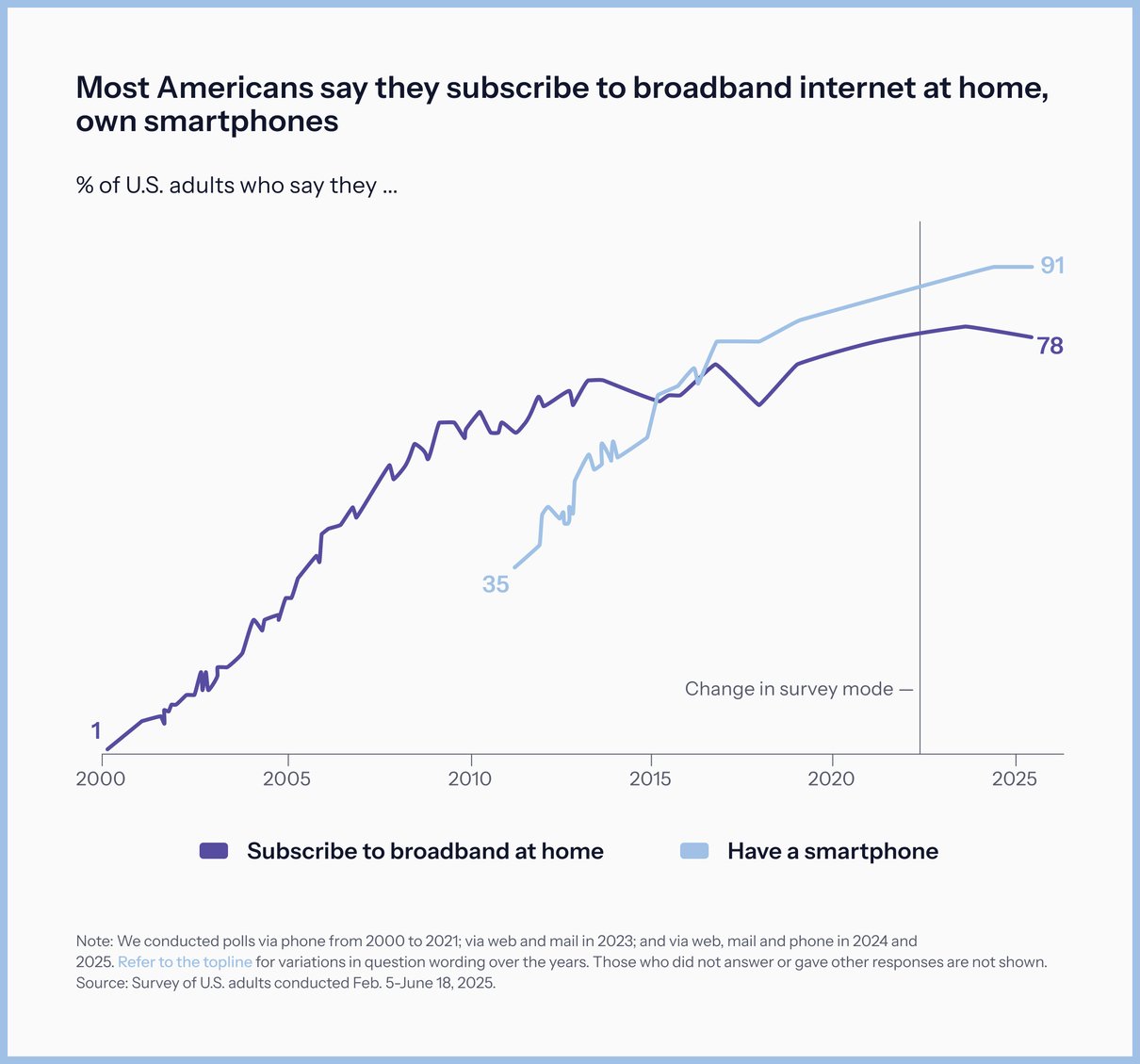
U.S. home broadband adoption and smartphone ownership, 2000–2025. Source: Pew Research Center.
The connectivity gap is even wider at the global level. According to the International Telecommunication Union’s 2025 data, 94% of people in high-income countries used the internet, compared with just 23% in low-income countries.
The role of technology in the evolution of education
Moving away from physical textbooks to digital learning experiences such as immersive learning environments, gamified learning apps, or hybrid classes creates a need for updated, cybersecure devices. Either at home, in the office, or in class, these devices need to be safe from tampering and be able to be charged.
ForwardPass offers a wide range of charging and device management solutions. Smart lockers provide easy-to-use and secure ways to manage mobile devices in classrooms.
As part of the EdTech infrastructure schools rely on, the ForwardPass workflow automation platform supports secure device access and automated handoffs when students need a working device.
When a student’s device breaks, the disruption extends beyond the repair itself. IT still has to collect the damaged device, provide a temporary replacement, track the handoff, and return the original device once it is ready.
ForwardPass can move much of that process into a self-serve workflow, allowing students to drop off a failed device and collect an authorized loaner or replacement from a smart locker. This reduces the amount of routine coordination required from IT while helping students regain access to a working device sooner.
Read more: Explore how higher education smart lockers support self-serve device access, loaners, repairs, replacements, charging, and campus-scale device management.
What will happen to education in the future?
The future of education will be shaped less by the availability of new technology than by how well schools manage its risks, costs, and instructional value.
AI is likely to remain one of the strongest forces shaping the future of education trends; however, analysts raise several concerns around the use of AI. For example, a 2025 World Economic Forum analysis of artificial intelligence in education argues that AI technology cannot replace the human relationships and sense of safety that contribute to effective education.
UNESCO’s 2025 work on AI and education highlights concerns around bias, privacy, accountability, and unequal access to technology. That tension makes AI adoption a practical governance issue.
There is also growing concern about cognitive offloading, where students rely on AI to perform mental work they would otherwise do themselves. A 2025 randomised controlled trial found that undergraduates who used ChatGPT as a study aid scored 57.5% on a surprise retention test 45 days later, compared with 68.5% among students who studied without AI.
The pace of technological adoption in education will also depend on whether schools can afford sustained investment in technology. McKinsey School Funding Model projected that U.S. K–12 funding would remain roughly flat at $969 billion in 2025–26 and $972 billion in 2026–27, while inflation continues to reduce purchasing power.
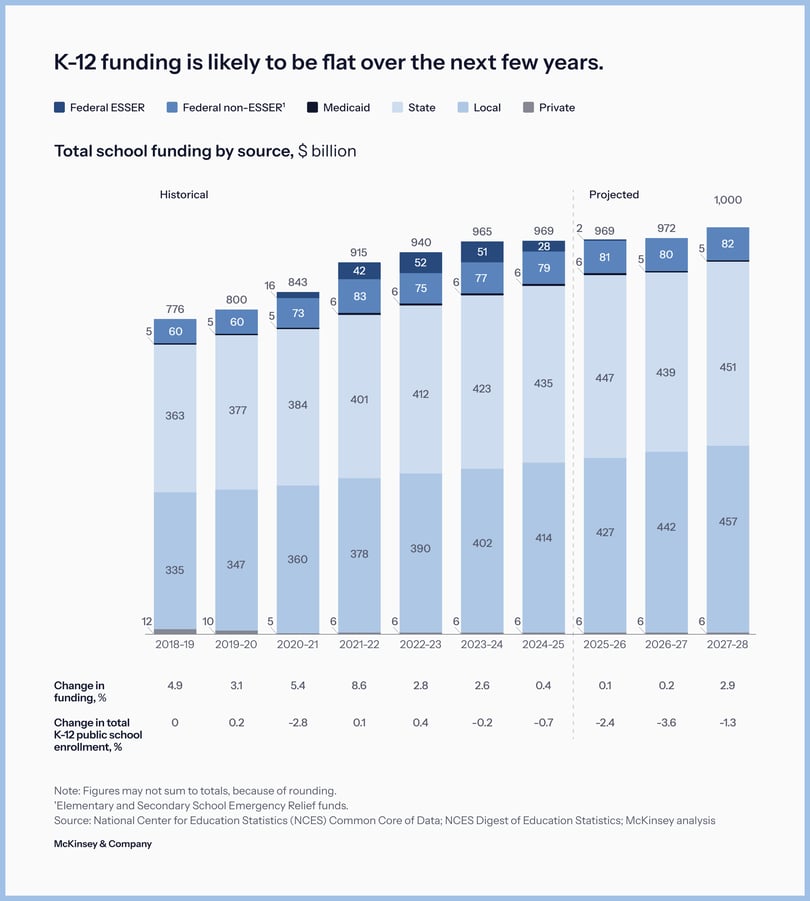
Historical and projected U.S. K–12 school funding by source, 2018–19 to 2027–28. Source: McKinsey & Company.
As a result, schools are likely to prioritise technologies that solve clear instructional or operational problems. Future adoption will depend on whether tools improve learning, justify their cost, and can be used without creating new risks.
Preparing for the future: Action steps for schools and districts
Education is critical for creating thoughtful, engaged, and empathetic adults. But how can educators embrace these trends to create a future of education that benefits us all? For educators, practical ways to prepare for these changes include:
-
Joining professional development workshops and seminars
-
Using technology to solve defined teaching and learning challenges
-
Staying up to date on policy changes
In addition, school districts can future-proof school operations by:
-
Using cloud-based solutions for data storage and virtual learning
-
Planning EdTech funding around the full education technology investment, including initial costs, support, maintenance, and replacement
-
Cultivating a community of innovation and improvement by providing ongoing training and support for faculty and staff
-
Strengthening cybersecurity through regular security audits, staff cybersecurity awareness training, and cost-effective IT management practices
Key takeaways
-
Education is entering a period of transition, with institutions balancing established teaching models against more flexible, technology-supported approaches.
-
Schools can assess the value of EdTech more clearly when each tool is tied to a specific teaching or operational problem.
-
Educators and district employees need a deep bench of technological readiness (e.g., staff that is well-versed in AI and cybersecurity).
-
Sustained EdTech adoption depends on funding, reliable infrastructure, and lifecycle planning for the technology they already use.
ForwardPass gives schools and higher education institutions a self-serve way to handle device loans, repairs, replacements, charging, and deployments. Students regain access to working technology faster, while IT spends less time coordinating routine handoffs.
Book a discovery to explore how ForwardPass could support your device management workflows.