The global smart locker market is a growing part of the broader locker market, combining connected hardware, software, and cloud-based platforms to manage secure access to devices, assets, and other stored items.
Smart charging lockers are part of this market, combining secure storage, power delivery, and connectivity. Demand for these systems is growing across applications such as device management, retail, workplaces, education, and other environments where controlled self-service access can replace manual handoffs.
This meta-analysis combines data from leading market research reports spanning 2021–2035, using 2025 as the base year to present a unified outlook on global adoption and investment trends in the smart locker market.
Additional reading: What is a smart locker? Discover how these systems combine secure storage, intelligent charging, and cloud-based device management.
Smart locker market size and growth forecast
The automated smart locker system market continues to expand, though reported figures differ across research sources. Cognitive Market Research, 360iResearch, and Business Research Insights use 2025 as the base year, with market projections ranging from $3.71 billion to $7.73 billion in 2026. Market estimates vary in scope depending on whether they include parcel, refrigerated, smart charging, or enterprise asset lockers.
The 2026 smart locker market estimates and 2026–2035 forecasts are the following:
-
Cognitive Market Research values the global smart locker market at $2.35 billion in 2025 and forecasts it to reach $5.74 billion by 2033, at an 11.8% CAGR. Its scope includes generic, parcel, staff and employee, and asset management lockers, with hardware, software, and services included in the market.
-
360iResearch estimates the global smart locker market at $3.28 billion in 2025 and projects it to reach $3.71 billion in 2026 and $7.97 billion by 2032, at a 13.53% CAGR. Its scope covers connected locker systems across parcel delivery, retail, residential, workplace, healthcare, education, and other institutional applications.
-
Business Research Insights expects the global smart locker market to reach $7.73 billion in 2026 and $10.96 billion by 2035, with a 4% CAGR from 2026 to 2035. Its scope includes parcel, asset management, temperature-controlled autonomous lockers, and intelligent charging lockers used across commercial, logistics, public-sector, and other organizational environments.
Smart lockers market share by region (2021-2033)
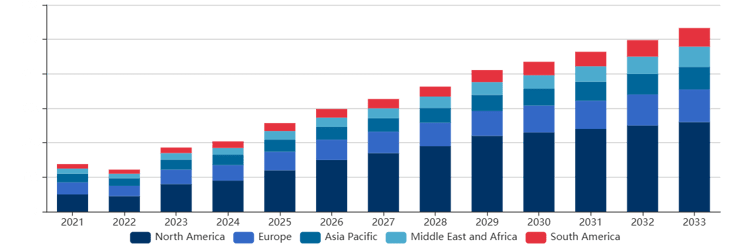
Credit: Cognitive Market Research. The graph is provided for illustrative purposes.
North America
North America remains the leading region for smart locker adoption, supported by developed e-commerce networks, advanced logistics infrastructure, and strong consumer demand for automated access.
Cognitive Market Research values the North American smart locker market at $870.17 million in 2025, representing more than 37% of global revenue. Within the region, the U.S. market is valued at $686.56 million. The North American smart locker market is projected to reach $1.81 billion by 2033 at a 9.6% CAGR from 2025 to 2033.
Regional companies such as ForwardPass, Signifi, and Luxer One continue to develop cloud-connected smart locker platforms for automated access and management.
Europe
Europe holds the second-largest share of the global smart locker market. Adoption is supported by established parcel networks, retail automation, and growing use of connected lockers in commercial environments.
Cognitive Market Research values Europe’s smart locker market at $682.02 million in 2025, accounting for more than 29% of global revenue. The report projects the regional market to grow to $1.47 billion by 2033 at a 10.1% CAGR from 2025 to 2033.
Sustainability initiatives, data protection requirements, and smart city investments continue to influence locker deployment across the region. Companies such as Quadient and Cleveron lead innovation through AI integration and cloud-based analytics that enhance last-mile delivery and enterprise workflow management.
Asia-Pacific
Cognitive Market Research values the Asia-Pacific smart locker market at $564.43 million in 2025, accounting for around 24% of global revenue. The report projects the Asia-Pacific smart locker market to reach $1.58 billion by 2033 at a 13.8% CAGR from 2025 to 2033, the fastest regional growth rate covered.
Rapid urbanization, expanding retail ecosystems, and government-led digitalization efforts in China, Japan, and South Korea are creating favorable conditions for smart locker implementation across retail, logistics, and public infrastructure.
Middle East and Africa
The Middle East and Africa currently account for a relatively small share of the global smart locker market.
Cognitive Market Research values the Middle East smart locker market at $89.37 million in 2025, or about 3.8% of global revenue. The report projects the Middle East smart locker market to reach $203 million by 2033 at a 10.8% CAGR from 2025 to 2033.
Africa contributes another $51.74 million in 2025, or roughly 2.2% of global revenue, bringing the two regions’ combined market value to approximately $141.1 million. The African smart locker market is projected to grow to $123.6 million by 2023 at an 11.5% CAGR from 2025 to 2033.
E-commerce growth and investment in digital infrastructure continue to support deployment in markets such as Saudi Arabia, the UAE, and South Africa.
South America
South America accounts for a smaller but growing share of global smart locker revenue. Brazil represents the largest national market within the region in Cognitive Market Research's analysis.
Cognitive Market Research estimates South America’s smart locker market at $94.07 million in 2025, representing more than 4% of global revenue. The report projects the South American smart locker market to reach $218.4 million by 2033 at an 11.1% CAGR from 2025 to 2033.
Brazil leads regional adoption, while growing e-commerce activity supports further locker deployment across Argentina, Colombia, Peru, and Chile.
Key market segments and applications
The most common smart locker use cases include logistics, education, healthcare, and workplace automation, reflecting the technology’s flexibility across various operational environments. These segments demonstrate how smart lockers have evolved into essential infrastructure for secure, efficient, and traceable workflows.
Workplace and IT asset management
In modern workplaces, managing shared devices and maintaining uptime for remote or hybrid teams has become a growing priority. Smart lockers for offices enable self-service pickup, return, and deployment of IT assets, removing manual handoffs and reducing IT workload. They merge charging, tracking, and identity-based access into one automated system.
Key applications include:
-
Device management automation with real-time visibility across assets
-
Self-service exchanges that let employees collect or return devices at any time
-
Integration with systems such as Azure AD, Okta, or ServiceNow for automated workflows
-
Cloud dashboards that provide insights into locker usage and energy performance
“In modern offices and schools, they [smart lockers] provide students and employees with secure, temporary personal storage, removing key management challenges and improving space efficiency.” — Verified Market Research
Education and campus management
Schools are using smart lockers for structured storage and access to devices. eSchool News reports that districts are adopting smart lockers to support phone-free policies through centralized, secure storage with controlled access and charging capabilities.
Self-service pickup and return make device deployment and replacement faster, cutting downtime and minimizing classroom interruptions.
Common applications include:
-
Student device loans and returns managed through ID badges or Single Sign-On (SSO)
-
Automated replacement of broken or lost devices to keep lessons on schedule
-
Digital tracking of each access event for improved accountability
-
Secure, accessible storage for tablets and accessories in shared learning areas
Logistics and parcel delivery
The logistics industry remains the largest adopter of smart lockers, driven by rapid e-commerce growth and demand for reliable last-mile delivery. Automated parcel lockers are a growing segment of the global locker market, driven primarily by retail and e-commerce delivery.
According to PW Consulting, the worldwide automated parcel locker market reached $1.35 billion in 2025 and is projected to grow to $3.37 billion by 2032, at a 13.98% CAGR. Retail and e-commerce accounted for 51.5% of global revenue in 2025, making them the largest end-user segment.
This reflects broad adoption among couriers, retailers, and postal operators. Automated systems enhance distribution efficiency, improve user convenience, and lower operational costs.
Key applications include:
-
24/7 contactless parcel collection and delivery
-
Temperature-controlled lockers for groceries and medical supplies
-
IoT-enabled tracking that improves visibility across the delivery process
-
Simplified return systems that reduce processing time and associated expenses
Healthcare
Smart lockers can support healthcare workflows that require secure, controlled access to medication and other sensitive items. For medication dispensing, they can extend access beyond staffed pharmacy counters while keeping collection tied to an authorized user.
Typical healthcare applications include:
-
Secure medication dispensing and collection
-
Controlled access to shared clinical equipment
-
Self-service handoffs between staff and support teams
-
Temperature-controlled storage where required
A 2024 PLOS ONE study examined adoption of smart lockers for chronic-disease medication dispensing among 1,133 patients and healthcare workers across five Nigerian states. The study found that 51% of patients and 43% of healthcare workers were very likely to accept smart lockers for medication dispensing.
Retail and e-commerce
Smart lockers support retail operations in two distinct ways: they automate customer order pickup and manage the devices employees use in stores. This makes smart locker deployment in retail stores relevant to both fulfillment and day-to-day operations.
For BOPIS (buy online, pick up in store) and click-and-collect, lockers give customers a self-service pickup point after an online order has been prepared. According to Mordor Intelligence, retail and e-commerce accounted for 38.53% of the global automated smart locker market in 2025, largely through click-and-collect programs.
The same model is also accessible beyond the largest retail chains. Subscription agreements and locker-as-a-service models are growing because they reduce the need for a large upfront hardware purchase, making deployment more practical for smaller and mid-market retailers.
Enterprise retailers also use smart lockers behind the scenes to manage shared store technology. In this role, enterprise device lockers for retail provide controlled access to shared scanners, tablets, and similar equipment while keeping devices stored and charged between uses.
Smart locker cost and pricing
Smart locker hardware typically costs between $2,500 and $21,000 per unit, depending on configuration and deployment requirements, according to Mordor Intelligence. Mordor Intelligence also reports that hardware accounted for 67.27% of market revenue in 2025, while software subscriptions are a growing part of smart locker pricing.
Commercial lockers are commonly purchased as hardware with an upfront capital cost or through a subscription model that combines hardware access with recurring software fees. The commercial locker cost is typically driven by:
-
Bay count, size, and density
-
Temperature-controlled or refrigerated compartments
-
Software capabilities and subscription tier
-
Integration with identity, asset, or business systems
Because these costs continue beyond installation, total cost of ownership (TCO) is more useful than the initial purchase price alone. TCO captures hardware, software, integration, maintenance, and other recurring costs over the expected life of the deployment.
Scalability and multi-site deployment of smart lockers
A scalable locker platform can add lockers and sites without rebuilding the management layer or creating a separate operating process for each location.
When assessing which locker systems support cloud-based management and multi-region deployment, organizations should look for a centralized environment that can manage multiple locations while maintaining consistent workflows, access policies, and reporting.
The ForwardPass workflow automation platform provides one example of this model for device management. Its cloud platform can manage multiple locker locations from a single environment while keeping device handoff workflows consistent across sites.
Administrators retain centralized visibility into locker activity, while distributed locations can use the same Loaners, Repairs, Deployments, Replacements, and Charging workflows without creating a separate management system for each site.
This approach allows organizations to expand locker coverage as demand grows without changing how routine device handoffs are managed. Central IT teams can maintain visibility across locations while each site continues to support its own device activity.
Technology trends shaping the smart locker system market
Ongoing growth in the smart locker market is driven by advances in IoT connectivity, secure user authentication, and modular software integrations that improve remote management, usage visibility, and integration with broader IT systems.
IoT connectivity and data-driven intelligence
The Internet of Things (IoT) has become the backbone of modern locker networks. Through built-in sensors and connected components, operators of IoT locker systems can track locker occupancy, temperature, and door activity in real time.
This continuous flow of data provides actionable insights that support predictive maintenance across multiple locations. Cloud-based dashboards allow administrators to evaluate asset utilization and service efficiency more effectively.
Key technological capabilities include:
-
Real-time monitoring and alerts that detect tampering, equipment faults, and maintenance requirements
-
Real-time occupancy tracking that shows which locker bays are available, in use, or occupied at any given time
-
Cloud synchronization that consolidates data from different sites for full fleet visibility
Secure authentication and access control
As locker networks expand into enterprise and public environments, security and user authentication remain critical. According to Gartner, organizations increasingly pursue 100% Single Sign-On (SSO) integration, making it a defining requirement for enterprise smart lockers.
This focus encourages the use of identity-based verification, alongside other authentication methods, to maintain flexibility, protect data, and support reliable user access across varied environments.
Common authentication technologies include:
-
Single Sign-On (SSO) integration with identity management platforms such as Okta or Azure AD
-
Barcode, QR code, or username/password access
-
Encrypted communications and role-based permissions that safeguard privacy and system integrity
Smart charging and software interoperability
As connectivity and access control capabilities evolve, innovation increasingly focuses on how lockers power devices and connect with enterprise systems. A key enabler of this interoperability is the growing adoption of API-first design strategies.
According to Postman’s 2025 State of the API Report, 82% of organizations have adopted API-first principles to some degree, while 25% describe themselves as fully API-first. This approach promotes open integration, enhancing the scalability, sustainability, and intelligence of locker networks.
Key developments include:
-
Smart charging technology that optimizes energy use, prevents overcharging, and monitors power performance in real time
-
Open APIs linking lockers with facility management, ITSM, and logistics systems for automated workflows
-
Modular cloud software that enables centralized management, remote updates, and new feature deployment
-
Advanced analytics that predict maintenance needs, reduce downtime, and extend asset lifespan
Key players and competitive landscape
Smart locker providers address different use cases, including IT asset management, parcel delivery, and access control. The clearest way to compare smart locker providers is to separate their primary application from their stated differentiators.
|
Vendor |
Primary focus |
Differentiator |
|
ForwardPass |
IT asset management and workplace operations |
Pre-built workflow automation for complete device handoffs |
|
Signifi Solutions |
Enterprise smart locker systems |
AI-enabled analytics and predictive maintenance |
|
Luxer One |
Parcel and residential lockers |
Security and contactless delivery |
|
ASSA ABLOY |
Public and enterprise access control |
Integrated access control and locking technologies |
|
Quadient, Parcel Pending, and Ricoh USA |
Large-scale parcel and document management |
Systems designed for high-volume parcel and document workflows |
|
Nuwco and American Locker |
Corporate and institutional locker infrastructure |
Modular, heavy-duty locker designs |
The most competitive providers focus on energy efficiency, cloud-based interoperability, and data-driven intelligence to support flexible and scalable deployments.
For organizations comparing solutions, the guide on smart locker buying tips covers the technical, operational, and service factors to evaluate before implementation.
Market drivers and challenges
Market research consistently identifies the same core factors shaping the smart locker industry. Rapid digitalization, evolving workplace models, and the global move toward automation continue to drive adoption. Yet, cost, integration complexity, and security remain major concerns for organizations seeking large-scale deployment.
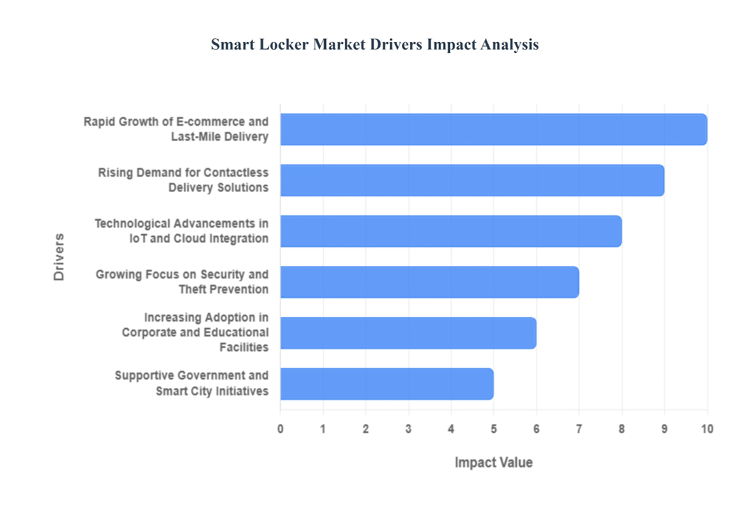
Drivers
The growing need for contactless, automated, and sustainable systems is redefining how organizations manage deliveries, assets, and workplace logistics. Smart lockers align with this transformation by linking physical operations to digital oversight.
Beyond improvements in IoT and cloud integration, key market growth trends include:
-
Expansion of remote and hybrid work: Companies require secure, self-service systems for device exchanges and IT asset control.
-
E-commerce and last-mile delivery growth: Online retail continues to accelerate, increasing the need for automated, theft-resistant parcel lockers.
-
Device mobility and automation: More organizations depend on shared mobile devices, prompting demand for smart charging lockers.
-
Sustainability initiatives: Centralized delivery hubs can reduce delivery-related emissions and packaging waste, supporting broader environmental goals.
-
Scalability demand: Organizations need locker systems that can expand across locations and workflows as device fleets, user populations, and operational requirements change.
Credit: Verified Market Research
Challenges
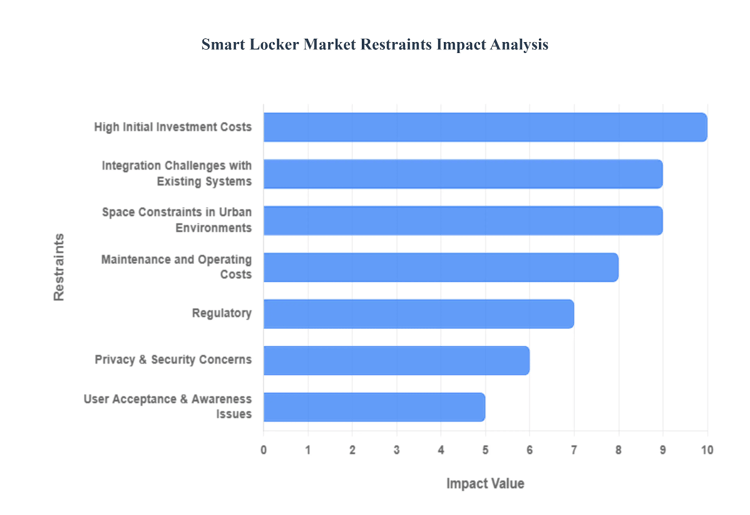
Despite steady growth, smart locker adoption continues to encounter practical and financial obstacles that differ across regions and applications. The pace of market expansion depends on how well vendors and users resolve these recurring issues:
-
High installation and maintenance costs. Hardware, networking, and power requirements create an entry barrier for smaller organizations.
-
Integration complexity. Connecting lockers to legacy IT, ERP, and logistics systems often demands specialized technical expertise.
-
Data security and compliance risks. Managing user credentials introduces privacy vulnerabilities and cybersecurity threats.
-
Operational upkeep. Regular maintenance and software updates are vital for system reliability and user confidence.
-
User acceptance and awareness issues. Some consumers and facility operators remain cautious toward smart locker technology due to unfamiliarity, perceived complexity, or limited trust in automation.
Credit: Verified Market Research
Balancing innovation with affordability and security will define the industry’s ability to scale sustainably over the next decade.
Is investing in smart lockers worth it?
Smart locker ROI depends on whether the system’s operational value outweighs its total cost of ownership. Rather than relying on a universal payback figure, organizations should compare their current device-handling costs and service gaps with the results achieved after deployment.
The most useful ROI indicators are:
-
Staff time saved: Measure whether routine device handoffs require fewer manual interventions after deployment.
-
Workflow completion: Track how often users complete pickups, returns, replacements, or other exchanges without staff assistance.
-
Asset accountability: Compare the frequency of unclear custody, missing devices, or incomplete handoff records before and after deployment.
-
Device availability: Monitor whether employees spend less time waiting for, locating, or replacing shared equipment.
-
Locker utilization: Check whether installed capacity is being used consistently enough to justify hardware, software, and operational costs.
Taken together, these measures show whether the system is removing enough operational friction to offset its total cost of ownership. Smart locker ROI is strongest when deployment aligns with recurring demand and delivers measurable improvements in the workflows it supports.
Future outlook: What’s next for smart locker systems
The future of the smart locker market will be shaped by predictive maintenance, energy optimization, and innovations in sustainable hardware.
Predictive maintenance
Predictive maintenance powered by AI and IoT analytics is becoming a core capability for connected infrastructure. The AIoT market — which combines artificial intelligence with the Internet of Things — is projected to reach $79.13 billion by 2030 according to MarketsandMarkets. This integration supports predictive maintenance, helping reduce downtime, extend asset lifespan, and improve operational efficiency across large locker networks.
AI-powered charging and energy optimization
Artificial intelligence is reshaping how organizations manage and conserve energy. At Siemens, AI-based systems cut overall energy consumption by 25% and reduced both carbon footprint and per-product energy use by 50%.
As AI optimization expands beyond manufacturing, similar advancements are expected to enhance intelligent locker systems through predictive charging, dynamic load balancing, and real-time energy efficiency monitoring.
Modular design and sustainable locker systems
Hardware production is shifting toward modular, repairable, and recyclable configurations that extend product lifespan and reduce material waste. Dell exemplifies this approach through its 2030 commitment to reuse or recycle an equivalent product for every item sold and to rely exclusively on recycled or renewable packaging materials.
These goals reflect the industry’s broader movement toward circular design. In parallel, smart locker manufacturers are adopting modular frames, swappable parts, and recyclable components to improve both sustainability and serviceability.
Additional reading: Learn more about the benefits of smart lockers and how these systems enhance user experience, streamline workflows, and strengthen operational efficiency across workplaces, educational institutions, and logistics environments.
Conclusion: ForwardPass insights on the evolving market
The global smart locker ecosystem continues to mature into a key component of digital infrastructure. Market reports converge on a shared outlook: automation, sustainability, and intelligent engineering will define the next decade of growth.
- Smart infrastructure now underpins last-mile delivery, workplace automation, and device management.
- Smart locker scalability allows organizations to expand capacity as demand grows across users, workflows, and locations.
- IoT connectivity, AI analytics, and modular architecture remain the strongest catalysts for market expansion.
- The fastest adoption is occurring in logistics, education, and hybrid work environments.
- Integration, energy management, and data security are expected to shape investment strategies for years to come.
- Pricing of smart lockers includes hardware, software, integration, maintenance, and ongoing operating costs.
- Smart locker ROI comes from reducing manual effort, improving asset accountability, and limiting avoidable device losses.
ForwardPass leads this transformation through intelligent charging, automated workflows, and energy-efficient designs. By combining hardware reliability with data-driven intelligence, ForwardPass delivers locker systems that automate daily operations, improve uptime, and support long-term digital resilience.
Learn how ForwardPass smart charging automation can help future-proof your organization’s connected infrastructure. Book a discovery.