The best commercial model for smart locker systems depends on how you plan to fund, operate, and support the deployment over time. Buying generally suits stable long-term deployments, leasing fits organizations that want to spread hardware costs, and subscribing works well when bundled hardware, software, and support are priorities.
This guide compares the three smart locker pricing models — buy, lease, and subscribe — across ownership, budgeting, support, total cost, contract terms, and long-term flexibility.
Key takeaways
- ForwardPass offers a subscription model that combines smart locker hardware with software and ongoing support.
- Confirm how the contract covers renewals, scaling, early exit, and end-of-term obligations.
- Compare smart locker pricing models over the five years to capture the total cost of each.
- Security assurance, including current SOC 2 documentation where relevant, should be part of vendor due diligence.
What is locker-as-a-service?
Locker-as-a-service is a subscription model that provides access to smart locker hardware alongside recurring software and support services. Unlike an outright purchase, the provider typically retains ownership of the hardware during the subscription term, depending on the agreement.
This model can suit organizations that want to reduce capital outlay and shift more lifecycle responsibility to the vendor, while accepting contract-based renewal and end-of-term conditions.
Buy, lease, or subscribe: The three smart locker models compared
Buying smart lockers generally gives you the most ownership and long-term control, while leasing spreads the hardware cost over a defined term. Locker-as-a-service lowers the total initial investment through recurring payments that cover hardware access, software, and support.
The exact economics depend on what each vendor includes.
|
Criterion |
Buy (CapEx) |
Lease / lease-to-own / rental |
Subscription (locker-as-a-service) |
|---|---|---|---|
|
Upfront cost |
Highest; hardware purchased outright |
Lower; cost spread over term |
Low; recurring payments |
|
Hardware ownership |
Customer owns hardware |
Depends on lease and buyout terms |
Provider typically retains ownership during the subscription term |
|
Software and updates |
Often licensed separately |
Included or separate |
Commonly included |
|
Installation and shipping |
Included or separate |
Depends on the agreement |
Often bundled |
|
Maintenance and parts |
Separate or optional coverage |
Depends on the agreement |
Often included |
|
Warranty |
Standard hardware warranty |
Contract-dependent |
Warranty typically continues through term |
|
Scaling |
Requires additional purchases |
Requires lease expansion |
Units can often be added under the service agreement |
|
Budget type |
Typically capital-oriented |
Depends on classification |
Typically operating-oriented |
|
End of term |
Keep the hardware |
Return, renew, or purchase |
Return, renew, or purchase |
|
Contract flexibility |
High after purchase; software terms may still apply |
Limited by term, renewal, and buyout conditions |
Limited by term, renewal, and buyout conditions |
What a ForwardPass smart locker subscription includes
A ForwardPass subscription combines access to smart locker hardware with the software and services required to operate the system over the contract term. The exact commercial terms and service coverage depend on the customer’s subscription agreement.
Depending on the agreement, a ForwardPass subscription can cover:
- Smart locker hardware: Access to the locker system for the contracted service period.
- Cloud software: Access to ForwardPass workflows and related cloud services.
- Software updates: Updates are managed as part of the software service.
- Technical support: Support for the ForwardPass service and associated products.
- Hardware warranty: Included for the subscription term.
- Additional services: Installation, shipping, maintenance, and lifecycle services depend on the individual agreement.
Read more: See what a smart locker subscription includes, from hardware and installation to software, support, and lifecycle services.
ForwardPass product warranty
ForwardPass hardware is covered by a limited product warranty against defects in design, materials, assembly, and workmanship. Coverage periods vary by component under the current ForwardPass Product Warranty:
- Product frames: 10 years
- Mechanical and electrical components: 2 years
- Cables and other limited-life items: 1 year
Smart locker total cost of ownership: The 5-year TCO worksheet
In practice, how much smart lockers cost depends on the total long-term cost. However, for an outright hardware purchase, mid-range smart locker systems generally cost $3,000–$12,000 per unit.
To compare buying, leasing, and subscription fairly, calculate each model over the same five-year period. Add every applicable cost for each year, including software, installation, shipping, support, repairs, internal IT labor, and any refresh or end-of-term expenses.
Enter those costs in the worksheet below, total each model across all five years, and compare the final figures alongside what each agreement includes.
|
Cost category |
Year 1 |
Year 2 |
Year 3 |
Year 4 |
Year 5 |
|---|---|---|---|---|---|
|
Hardware purchase |
|||||
|
Software licenses and renewals |
|||||
|
Installation and setup |
|||||
|
Shipping and freight |
|||||
|
Support and training |
|||||
|
Parts and repair costs |
|||||
|
Hardware refresh and disposal |
|||||
|
Internal IT labor |
|
Cost category |
Year 1 |
Year 2 |
Year 3 |
Year 4 |
Year 5 |
|---|---|---|---|---|---|
|
Lease payments |
|||||
|
Software licenses and renewals |
|||||
|
Installation and setup |
|||||
|
Shipping and freight |
|||||
|
Support and training |
|||||
|
Parts and repair costs |
|||||
|
End-of-term or buyout costs |
|||||
|
Internal IT labor |
|
Cost category |
Year 1 |
Year 2 |
Year 3 |
Year 4 |
Year 5 |
|---|---|---|---|---|---|
|
Subscription fees |
|||||
|
Software or platform fees not included in the subscription |
|||||
|
Installation and setup |
|||||
|
Shipping and freight |
|||||
|
Support and training not included in the subscription |
|||||
|
Parts or repair costs not included in coverage |
|||||
|
End-of-term return or removal costs |
|||||
|
Internal IT labor |
How to choose a smart locker pricing model: Questions to ask
The right smart locker model depends on how you plan to fund, operate, and maintain the system over its useful life. Buying hardware favors long-term ownership, while leasing and subscription can reduce upfront spending or shift more costs into recurring payments.
How will you fund the project?
Your available funding should narrow the commercial model before you compare features. One-time capital can favor buying, while recurring operating funds may make leasing or subscription more favorable.
Here are a few considerations on the models:
- Buy: One-time capital funding is available, and you want to own the hardware.
- Lease: You want to spread hardware costs across a defined term.
- Subscription: You prefer recurring costs instead of budgeting separately for maintenance, support, and software.
Technology budgets are not always predictable, especially in education. For example, in EDUCAUSE’s 2025 QuickPoll on technology budgets and staffing, 42% of higher education respondents expected their IT budgets to decrease in 2025–2026, with a median expected reduction of 8%.
How much ongoing IT responsibility can you absorb?
Your internal IT capacity should influence how much operational responsibility you keep in-house. Buying generally requires more direct ownership of support and lifecycle tasks, while subscription can shift more of that work to the provider.
Your available IT capacity can narrow the choice:
- Buy: Your team can manage support, software, maintenance, and refresh responsibilities.
- Lease: Your team can absorb some ongoing responsibilities, with the rest depending on what the lease covers.
- Subscription: You want more ongoing responsibilities covered under one service agreement.
In CoSN’s 2026 U.S. State of EdTech report, 34% of respondents said they lacked sufficient staff for district technical support, including application support and network administration. Similar capacity concerns appear outside education.
For example, in ASSA ABLOY’s 2025 Wireless Access Control Report, a broader survey of security, facilities, access-control, and IT professionals found that 21% cited managing IT infrastructure costs as a goal for adopting Access Control as a Service, while 18% cited managing headcount.
How long do you expect to use and expand the system?
Your expected deployment horizon should influence whether ownership or a term-based model offers better value. Buying can make more sense for a stable, long-term program, while leasing or subscribing may fit better if capacity or deployment needs could change.
The expected deployment timeline can help narrow the choice:
- Buy: You expect a stable, long-term deployment and want ownership to provide value over time.
- Lease or subscribe: The deployment horizon is less certain, and you prefer to avoid a long-term hardware commitment.
Because smart lockers can remain in service for many years, expected lifespan matters when comparing ownership with term-based models. For example, Utah’s 2025 standard useful-life table assigns 10–15 years to security systems such as access-control hardware and cameras based on technology replacement cycles. A similarly long deployment horizon can strengthen the case for ownership, while a shorter or less predictable horizon can favor leasing or subscription.
How much contract flexibility do you need?
Contract flexibility determines how easily you can change, expand, or leave an arrangement as your needs evolve. Buying usually gives you more control over the physical hardware, while leasing and subscription place more weight on the agreed term and exit conditions.
Your tolerance for fixed terms can help narrow the choice:
- Buy: You want greater control over the hardware after purchase, though software terms may still apply.
- Lease or subscribe: You can work within a defined contract term and are comfortable planning around renewal, exit, and end-of-term conditions.
Contract flexibility is already a meaningful procurement criterion in adjacent physical-security systems. In Genetec’s 2026 State of Physical Security report, 37% of end users said they look for flexible contract terms and exit strategies when working with physical security vendors. More broadly, 73% prioritized long-term vendor viability and stability of the overall vendor relationship.
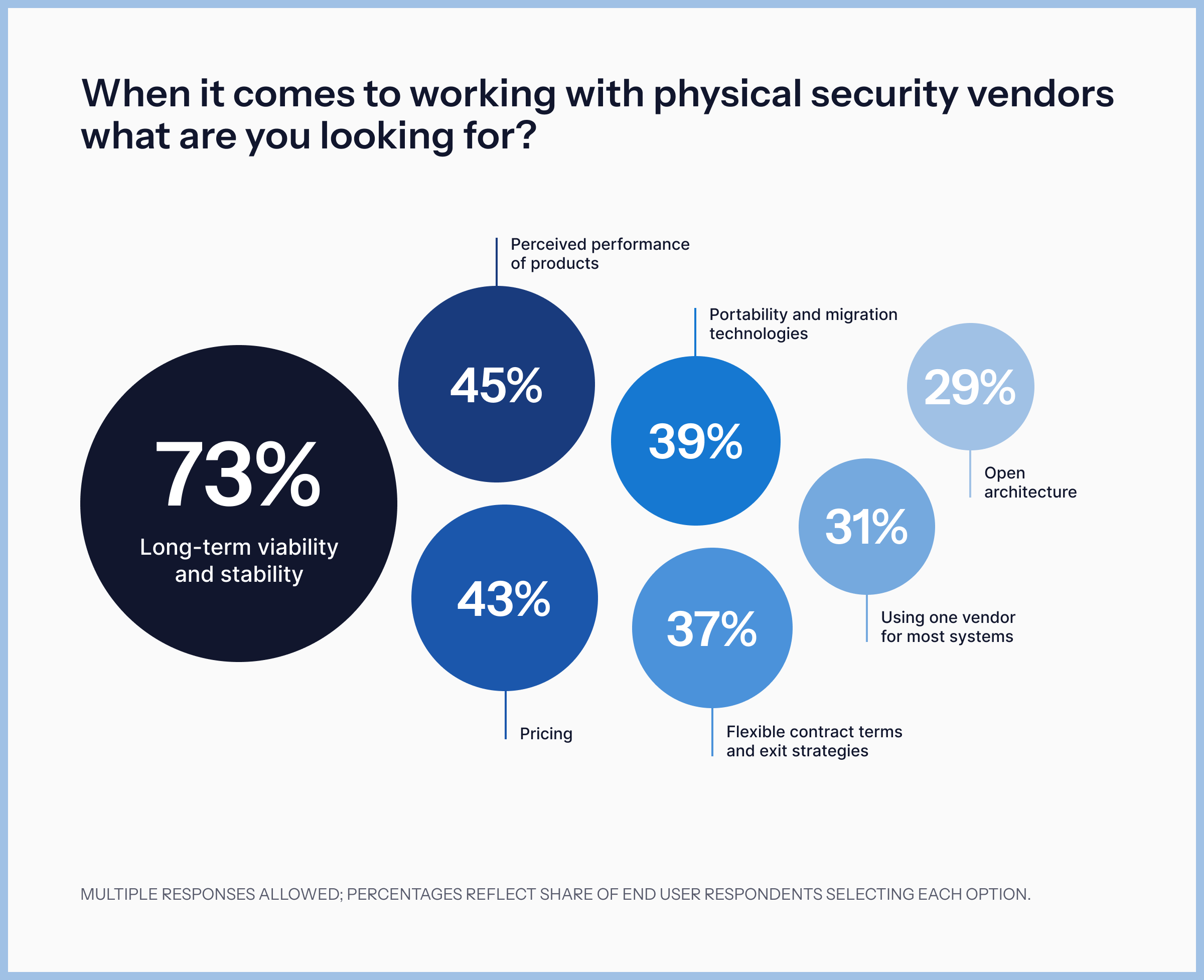
Figure: Physical security vendor selection priorities. Source: Genetec, State of Physical Security 2026.
How the decision changes by organization type
Organization type does not determine the commercial model, but it can change which constraints carry the most weight. For example, in smart lockers for education, limited internal capacity can make a term-based or subscription model easier to sustain.
|
Organization |
Typical pressures |
|---|---|
|
K-12 |
Grant/budget cycles, procurement rules, and limited IT capacity |
|
Higher education |
Campus growth, departmental demand, and funding complexity |
|
Workplace |
Site changes, device programs, and service needs |
Workplace requirements can shift over time, so smart lockers for offices may need to support changing sites and device programs.
Finance and procurement questions to ask
The funding model affects budgeting and future payment commitments. Buying may use a capital budget (CapEx), while lease or subscription payments may come from operating funds (OpEx).
Before approval, your financial team should process these questions regarding the arrangement:
- What are the budget implications of the CapEx vs. OpEx smart locker decision?
- How will this arrangement be classified for accounting purposes?
- Does the contract value or term trigger additional procurement approval?
- Will it create an asset or liability on the balance sheet?
- Which budget will fund the upfront and recurring costs?
- What additional (or higher) costs could apply during renewal, expansion, or at the end of the contract?
Leases covered by applicable accounting standards are generally recorded as both an asset and a corresponding liability. Under FASB ASC 842, this applies to most private-sector leases, while GASB Statement 87 applies similar treatment to leases for state and local governments.
For state and local governments, GASB Statement 96 extends similar asset-and-liability recognition to subscription-based IT arrangements that fall within its scope. Finance or the organization’s auditor should confirm which standard applies to the proposed agreement before signing.
Contract and exit checklist
Before signing, verify the terms that apply throughout the contract and at the end of the agreement. A suitable commercial model can still create problems if renewal, service, scaling, or exit conditions are unclear.
Use these questions when reviewing any vendor agreement:
- How long is the initial contract term?
- How does renewal work, and can pricing increase?
- Can you terminate early, and what fees apply?
- What happens to the hardware and your data at the end?
- What service levels and support response times are committed?
- Which repairs and replacement parts are covered?
- How are software updates and security fixes provided?
- How can you add or remove capacity, and at what cost?
- Can you purchase the hardware separately, if needed?
- What security assurance is available, including the SOC 2 report type, scope, and date?
Read more: Explore smart locker buying tips for evaluating security, integrations, total cost, scalability, and vendor support.
Bottom line
The right smart locker model depends on your funding, internal capacity, deployment horizon, and service needs. Compare five-year cost, accounting implications, contract terms, service coverage, scaling, and exit conditions to choose the model that remains practical over time.
ForwardPass offers a subscription model for organizations that prefer bundled hardware, software, and ongoing support. Book a Discovery to see if a ForwardPass subscription fits your deployment scenario.
Get practical guidance on comparing smart locker systems, evaluating vendor capabilities, and choosing a solution that fits your organization.
FAQ
Is it better to buy or lease a smart locker system?
When comparing buying vs. leasing a locker system, the key tradeoff is hardware ownership versus spreading costs over a defined term. Buying gives you ownership, while leasing reduces the upfront commitment by distributing payments over time.
Do smart lockers require a subscription?
No, smart lockers do not inherently require a subscription. Commercial models vary by vendor and may include outright purchase, smart locker leasing, or subscription arrangements with different software and support terms.
Smart locker software may still require a recurring license or subscription even when the hardware is purchased outright. ForwardPass uses a subscription-based commercial model that combines locker hardware with software, support, and lifecycle services, with terms varying by agreement. For broader product and workflow questions, see the ForwardPass smart locker FAQ.
How much does a smart locker subscription cost?
Smart locker subscription pricing depends on the hardware configuration, contract term, and included software, support, and services. Compare the total cost with other commercial models over a defined period, such as five years, rather than just the recurring fee.
What happens to the lockers when a smart locker subscription ends?
What happens at the end of a smart locker subscription depends on the contract. The hardware may need to be returned, or the agreement may offer renewal or purchase options, so confirm the end-of-term terms before signing.
Is a smart locker subscription a capital or operating expense?
A smart locker subscription may fit an operating budget, but the payment model alone does not determine its accounting treatment. Finance or the organization’s auditor should review the agreement because qualifying leases or subscription arrangements may need to be recognized differently.